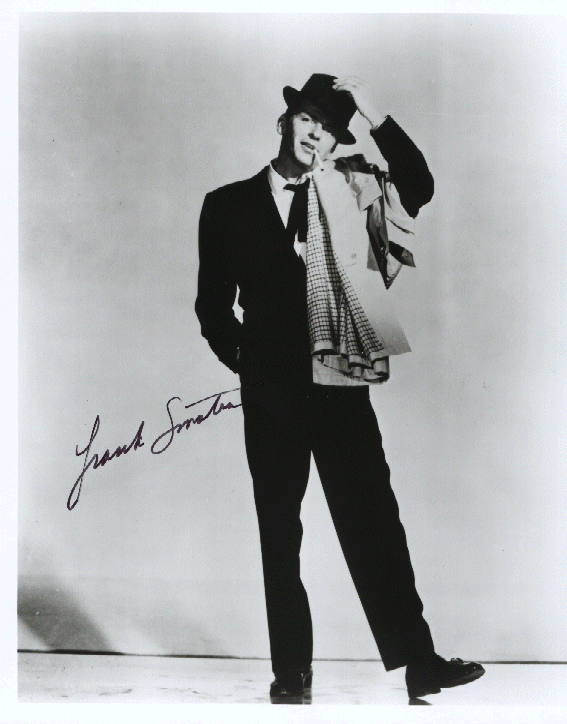
In 1953, Frank Sinatra is in deep personal crisis, artistic and financial. His contract with Columbia, was completed. Traumatic break with the true love of his life, the beautiful Ava Gardner, and the failure of his last recordings were shattered "The Voice" both professionally, and personally. Nobody gives a dime for an artist who, at the time, is, for all over. Their times were far from brilliant success, first with the Dorsey band and then solo. That time when alienated teenagers tirelessly pursued him to try just brushing the body of this young skinny and weak ballads that swept the hearts of his followers.
Sinatra began a "second career" and was now the Capitol label which, without much conviction, he again opened a door. In that year, began the most fruitful period, artistically speaking on Sinatra's career.
From their first album "Song for Young Lovers" to the last recorded for the label in 1961, the wonderful "Point of no return", Sinatra gave us for almost ten years, a great repertoire of recordings, in which gradually his voice and phrasing were gaining security and maturity, no doubt driven by Axel Stordahl arrangements and above all, his inseparable Nelson Riddle, which gave these recordings an eminently jazzy spirit. One must not forget that even when Sinatra is a singer of popular music, so is jazz, Sinatra recorded during his career, with the orchestras of Count Basie and Duke Ellington. Trumpeter Harry James became a regular companion in his recordings and performances. His singing, his phrasing, his improvisations on the melody were laden with a huge swing. It may suffice to recall that Miles Davis himself, which is hardly any quality attribute suspect a white man free, he said, he learned to phrase listening to Sinatra.
And, when listening to Sinatra often we ask where is the Secret. What is it that sets it apart from other great crooners like Bing Crosby and Tony Bennett?. No doubt the tone of your voice is crucial: It's manly, without vibrato, lacking any involvement.
Imaginémoslo: Alone on the stage or in the studio, in front of a microphone, back in the 50's, when the world was young. There is tipped his hat and his striped suit, Sinatra is eminently elegant. Maybe just ordered that "squeeze" some uncomfortable opponent of the Cosa Nostra (because, say, Sinatra was an "honorable man") or may have spent little before U $ S 50,000 in a casino in Las Vegas; da Like, intonation and phrasing are perfect. His authority is complete, the domain, all. In the study, Sinatra does not repeat the shots, the first not only the best, is the only possible. Sometimes longer words, adjust the intonation of the sentences, introduce constant counterpoint and variations on the melody, conveying a infectious swing. His voice is a suggestive nod to a listener fascinated by the personality of irresistible appeal. In the ballads avoids any easy sentimentality. Her technique is never tear baladistica but simply exciting.
But above all, Sinatra always convinces us that he has performed the song in the best manner in which it is possible. Maybe others do it differently, but he is the paradigm. It is difficult to explain why, perhaps because it is a feeling and it is always difficult to explain in words, or rather should not even try.
"Point of no return" in 1961, ends this unparalleled period in the career of Francis Albert Sinatra. Was this a time of great musical quality, but also huge commercial success. Length albums and singles like "Song for Swinging Lovers," "Sinatra swingin'session", "Only the Lonely", "Close to you", "No one cares", "Where are you", "Come fly with me "and many others are today, worship recordings, jewelry labels. Sinatra
created in that year his own Reprise label, with a period that began more commercial but also full of great recordings. But while the set of recordings made by the "voice" to throughout his career put him in a privileged place in the music of the twentieth century, those made for Capitol, Sinatra reserved a prominent place in the history of vocal jazz.
Very good version of "Just One Of Those Things"


0 comments:
Post a Comment