Thursday, August 23, 2007

How To Renew My Drivers License In Columbus ,ohio

Wes Montgomery: A


Despite his untimely death from a heart attack at age 45, the legacy of Wes Montgomery jazz is enormous. Wes is still the standard for modern jazz guitarists. Wes is to jazz what Jimi Hendrix is \u200b\u200bto rock. Crown

pioneer Charlie Christian, who died at age 26 when he still had much to say, Montgomery developed a sound and special technique based on the utilization of your thumb instead of the needle, and to use instead of complex chords only the classic line, all this added to his personal style of playing in octaves.

In the 1940's he toured with his brothers Buddy (piano and vibraphone) and Monk (bass), then joined Lionel Hampton's band and then return to his native Indianapolis, where he played almost the entire decade of 1950.

Recommended by Cannonball Adderley, Wes signed for the Riverside label in 1959 and in 1960 he recorded his masterpiece, "The Incredible Jazz Guitar" accompanied by the Heath Brothers and Tommy Flanagan on piano (the cover of Rollins' Airegin is enormous). In 1964 Verve goes to Riverside after collapse.
On Verve induce them to be less jazzy and more popular, to which access immediately slipping into the Latin with the addition of congas, strings and horn, although Montgomery did not read music, he managed to compose several songs interesting.

Wes Another memorable album is the live album recorded at the Half Note in New York: "Smokin 'At The Half Note" with organist Jimmy Smith.


Excellent version of the classic Monk's "'Round Midnight" recorded in March 1965 by the BBC. Harold Mabern accompany on piano, Arthur Harper on bass and Jimmy Lovelace on drums where you can enjoy the magic and calm that emanates from his guitar Wes.

Sunday, July 8, 2007

How Does Brazilian Waxing Look?


Various plastic INDICATED:


Photo 1: Mural of 3.50 m. x 2.5 m. mixed media, 1968, 2-3-4
Photo: Pastel on paper, 1995,
Photo 5: Painting on canvas, 1992,

Saturday, July 7, 2007

Genital Warts More Condition_symptoms Male


Wall Set: Collage gender and wool on oznaburgo made in 1990.

Photo 1 .- " Street people", dimensions 0.80 x 0.70cm. Photo2
.- " thousand faces", dimensions 0.50 x 1.30 cm.
Photo 3 .- " For missing" dimensions 0.60 x 1.50 cm.
Photo 4 .- " Pisagua " diemsiones 1.30 x 1.30 cm.

Wednesday, June 20, 2007

Bipolarcondition_symptoms

odd guitarist Benny Goodman: King of Swing


Its origins
Born in Chicago, Illinois on May 30, 1909, Benny Goodman was the ninth of twelve children and came from an impoverished family of Polish Jewish immigrants. Encouraged by his father to learn a musical instrument, Benny and his two brothers took clarinet lessons in Kehelah Jacob Synagogue and later at Hull House, an establishment founded by the reformer Jane Addams.
Since its inception, Goodman showed exceptional talent and was supported and sponsored by James Sylvester and later by the renowned Franz Schoepp.
Goodman made his first public performances before entering adolescence and soon shared the stage with the likes Jimmy McPartland, Frank Teschemacher, and Dave Tough. The talent led him to give him the professional musician card required by the union at the age of 14, the year in which also played with Bix Beiderbecke.
In his adolescence he was already considered a professional with all the letters and worked with many bands at the expense of vocational education. Ben Pollack in 1925 hired him for his band based in California and was there until 1929 when he decided to take up residence in New York and working as a sideman on recordings and radio.

His professional stage
the late twenties and early thirties Goodman and was a perfectionist and perhaps the country's most experienced clarinetist. At that time he participated in bands, tours, clubs and recordings with Red Nichols, Ben Selvin, Ted Lewis and Sam Lanin and others.

In 1934 his personal ambitions lead him to form a dance band and get a contract at the Billie Rose's Music Hall for a few months until management decides to change the profile of music theater. That same year
manages to win a place for six months to fill one of three places on the NBC radio for a new dance program called "Let's dance" that was broadcast on Saturday night. At that time, Goodman used the arrangements the likes of Fletcher Henderson and Lyle "Spud" Murphy, and included soloists as trumpeter Bunny Berigan, Red Ballard and trombonists Jack Lacey, the saxophonists Toots Mondello and Hymie Schertzer, in the rhythm section were George Van Eps on guitar Froeb on piano and Frank were later replaced by Allan Reuss and Jess Stacy respecticvamente. His brother, Harry Goodman was on bass and Stan King on drums which was soon replaced by the explosive Gene Krupa. The singer was Helen Ward, one of the most popular swing era.

Success
When the contract with NBC ended, Goodman, prompted by the producer John Hammond Jr. (who later became the producer of Columbia Records and discovered talents as Bob Dylan and Bruce Springsteen, among others), decided to organize a national tour with the orchestra. This tour led to many changes in personnel in the band, but strengthened in their sound coming in a big way to Los Angeles in August 1935. While the tour
had many ups and downs, on 21 August 1935, the orchestra comes to Palomar Ballroom with a contract for two nights, but the success is overwhelming and stay several months.
For many this is the time and place which is marked as the beginning of the "Swing Era."
From then on the fame of Benny Goodman and his orchestra are constantly rising and have a triumphant return to his native Chicago, more precisely in the Congress Hotel.
With the song "Moonglow" the band went to number 1 ranking and got two hits in the top ten with the songs "Take My Word" and "Bugle Call Rag."

Goodman At this time begins to make recordings in a trio with Krupa on drums and Teddy Wilson on piano, performing with this little training in various rooms.
In some places it was not well seen that promoted racial integration by including Wilson Goodman, who was black, on stage. This led him to be seriously questioned and even some contracts canceled. Goodman's response was to hire Wilson as a permanent member of his orchestra, the first white band that was famous among its members black musicians. In 1936 he added another notable black musician Lionel Hampton to form the famous Quartet. For its part, the big band and went on his way and was successful in his solo on trumpet Harry James, Ziggy Elman and Chris Griffin (Miles Davis said in his biography that he never again hear a trumpet session with both swing like this) . Vernon Brown trombonist and saxophonist Babe Russin and Arthur Rollini completed the training.
This year was to put 15 hits on the Top 10. The highlights: "It's Been So Long", "Goody-Goody", "The Glory of Love" "These Foolish Things Remind Me of You" and "You Turned the Tables on Me" all sung by
Helen Ward . Goodman
arrives with his orchestra to New York in 1937 and 3 March, according to critics of the time, offers a memorable role in the Paramount Theatre. That same year he participates in the movies "The Big Broadcast" and "Hollywood Hotel" and has an active presence on the radio program "The Camel Caravan" which lasted until the end of 1939.
Its success is becoming greater, and the January 16, 1938 offers a historic concert at Carnegie Hall, sealing his success and reputation and earning the nickname "The King of Swing."
Those interested, should listen to the recording of this concert, despite its technical shortcomings, we can enjoy the sound of the orchestra and the great time they were spending their soloists, especially Gene Krupa.
successes in the ranking are multiplied and placed at the top "Do not Be That Way", "I Let a Song Go Out of My Heart" sung by Martha Tilton
and Louis Prima song "Sing, Sing, Sing (With a Swing)."

After this successful concert, the band suffered several defections, Gene Krupa, Teddy Wilson and Harry James are going to form their own bands. Other musicians take other routes and while Goodman found good replacements and remained active as before, it was inevitable that the sound of the orchestra changed. Also in this year leaves the RCA Victor and passed to Columbia.
In 1939 "And the Angels Sing" sung by Martha Tilton
, achieved a first place in sales. In voting for the prestigious Down Beat magazine, Benny Goodman was elected as the best soloist and orchestra as the sextet took the number one in their respective fields.
New stage
In the early forties had great orchestra musicians as Cootie Williams, Sid Catlett and Georgie Auld and others. Helen Forrest was the new vocalist of the band and Peggy Lee was in its infancy with Goodman. "Darn That Dream" sung by
Mildred Bailey, "There'll Be Some Changes Made" sung by Louise Tobin , "Somebody Else Is Taking My Place" with the voice of Peggy Lee, the instrumental "Jersey Bounce" and "Taking a Chance on Love" sung by Helen Forrest were his successes in recent years.
the late '30s the quartet had expanded to form a sextet that included the guitarist Charlie Christian.
the late '40s Goodman flirted a bit with the Bop and made a combo with Doug Mettome, Stan Hasselgard, Wardell Gray, Fats Navarro, Stan Getz, Don Lamond, Jimmy Rowles, but soon gave up the genre.
The discovery of the tapes of the Carnegie Hall concert of 38 and their immediate release in 1953 prompted him to build again a Big Band and touring with Louis Armstrong, but the differences between the two stars were very deep and Goodman, citing a health problem, he stepped to the side of the project.

In 1955 he recorded the soundtrack for the movie based on his life ("The Benny Goodman Story"). The film but something very sugary and kitsch, has moments of very good jazz in the presence of Hampton, Wilson, James, Elman, Stan Getz, Back Clayton, Martha Tilton, and Krupa, in addition to the presence of Sammy Davis (the father of Sammy Davis Jr.) in the role of Fletcher Henderson, Kid Ory and the beautiful Donna Reed.

For the rest of the fifties Goodman continued to tour in small theaters in the company of small groups but always with good musicians like Ruby Braff and Urbie Green, among others. In Europe put together a big band on the occasion of the Brussels World Fair in 1958 and 1962 came tour the Soviet Union sponsored by the Department of State of the United States. In 1969 and 1970 big bands armed paths British musicians.

In the sixties and early seventies it was common for the quartet together with Wilson, Hampton and Krupa for events and also to act in clubs and on television, occasionally travel to Europe and Japan.
On January 16, 1978 recalled the anniversary of the legendary 1938 concert at Carnegie Hall and tried to reconstruct the magic spot that had won 40 years earlier.

The last years of his life was spent in Manhattan, where he was constantly remembered and honored. Benny Goodman died on June 13 1986, at age 77 at home playing a Brahms sonata.

His legacy
While some jazz critics deny the talents of Goodman and tend to ignore minoritised or passing through the jazz is impossible not to praise their technique, taste and remarkable swing.
An example is that many musicians in the world classical works composed for him. So Aaron Copland
dedicated his Concerto for Clarinet "in 1948, as well as Malcolm Arnold with his" Concerto for Clarinet No. 2 in 1974.

Goodman was a perfectionist who practiced every day for several hours a day until the end of his life.
was never idle, for when not playing jazz was devoted to his other love: classical music, especially Mozart, they recorded several albums with various symphony orchestras. Being a classically trained musician conservatory, its continuing search led him to adopt a different mouth and altering the sound of his playing.

While there has been criticism about his personality and ego, Goodman's achievements in the field of American popular music are virtually unmatched. Was once a musician best known and most popular United States in a highly competitive era, the devotion that fans and woke up in the rankings was higher than Louis Armstrong and Duke Ellington himself.
The trio and jazz quartet brought a sophistication never heard before, was a courageous pioneer who hired him to impose its choice of musicians regardless of skin color, broke racial barriers and was the one who launched the careers of many young musicians and talented as the aforementioned Charlie Christian and Lionel Hampton among others. Billie Holiday said in his biography that Goodman helped her and did record his first album when nobody believed in it.
never been an innovator like Armstrong, Ellington or Charlie Parker, however, was an important figure and played an important role in the history of Jazz.


Filmed over an interval of the movie "Hollywood Hotel" in 1937 can appreciate the sound of Benny Goodman's orchestra with the song "I've Got a Heartful of Music "and the final coupling with the quartet running" Avalon. "
are highlighted Harry James on trumpet, Gene Krupa on drums, Lionel Hampton on vibraphone and the same Goodman.

Wednesday, May 30, 2007

Wooden Fingerboards.com

The origin of the word Jazz


The appearance of the name "Jazz" comes from a series of anecdotes related to the Original Dixieland Jazz Band. Legend, and perhaps the most accepted of all existing, during the performance of this band in the Schiller's Café in Chicago in 1916, still under the name Johnny Stein's Band, a retired actor varieties stood up shouted "Jass it up, boys!" in an advanced state of intoxication. Until then "jass" was a word used in the slums of Chicago and southern blacks to refer to sexual pleasure and business. Until then nobody had used in reference to music.

Legend has it that this customer was hired to every night yelling "jass it up, boys" at the right time. Because of this the band soon became known as Stein's Dixie Jass Band, and when he moved to New York changed the name of The Original Dixieland Jass Band, and later, and a typographical error appeared as Jasz Original Dixieland Band, there change to Jaz and finally adopted the definitive Jazz.

The word Jazz already had sexual connotations ODJB before, but some dictionaries of the era and earlier even mention the word "jazz" as a synonym for copulation, vagina, sex, women considered only as sex objects ", even in the middle nineteenth century was used as a verb Creole in the jargon as "exciting, stimulating, speed things up:" That Thing jazz. " Also used the word "Jazzy" to refer to people who dressed conspicuously.

probably at first the word "Jazz" was used pejoratively to refer to this "new" music and its origins in brothels and brothels.


"Basin Street Blues" is one of the more traditional jazz songs. This video from 1959 recorded in Germany presented to Louis Armstrong and his All Stars. Louis Armstrong on vocals and trumpet, Young TRUMMY on trombone, Peanuts Hucko on clarinet, Billy Kyle on piano, Mort Herbert on bass and Danny Barcelona (who died last April 1, 2007) on drums.

Thursday, May 10, 2007

2010 Aggressive Skates

In 90 ... 6 .-


To read the winning story click here .

Saturday, April 14, 2007

Greeting For A Church Program

PICTURES AND MODELING


was just so 1981 and toffee was not necessary.
Boutique Fashion Show Iris at the Casino San Remo

Saturday, February 24, 2007

Pokemon World Online For Mac How To Set Up


William Ward Model.
Photo 1 .- Carlos Gonzalez for photo series on the Dunes Iquique, 1982.
Photo 2 .- Photo by Carlos Carpio L. , 1980. Digital Treaty, Ward 2005. 3 .-
Stock Photo Pepe Gonzalez Anniversary Performance Enei for Tiuna, 1976. Ex-Oficina Santa Laura, Actors: Gloria Jimenez and William Ward

Friday, February 23, 2007

Allergy Treatment More Condition_symptoms


1978, Photographer: Carlos Carpio. Location: ex nitrate
Kirima
Photo 1 .- Models: Waldo Nuñez, Guillermo Zuniga Ward and Lito.
Photo 2 .- Models: Guillermo Nuñez Waldo Ward and

Thursday, February 22, 2007

Obsessive Thinking More Condition_symptoms


The hands are the eyes of the CIEJ ...

Thursday, February 15, 2007

Fecal Incontinence Swimming Pants

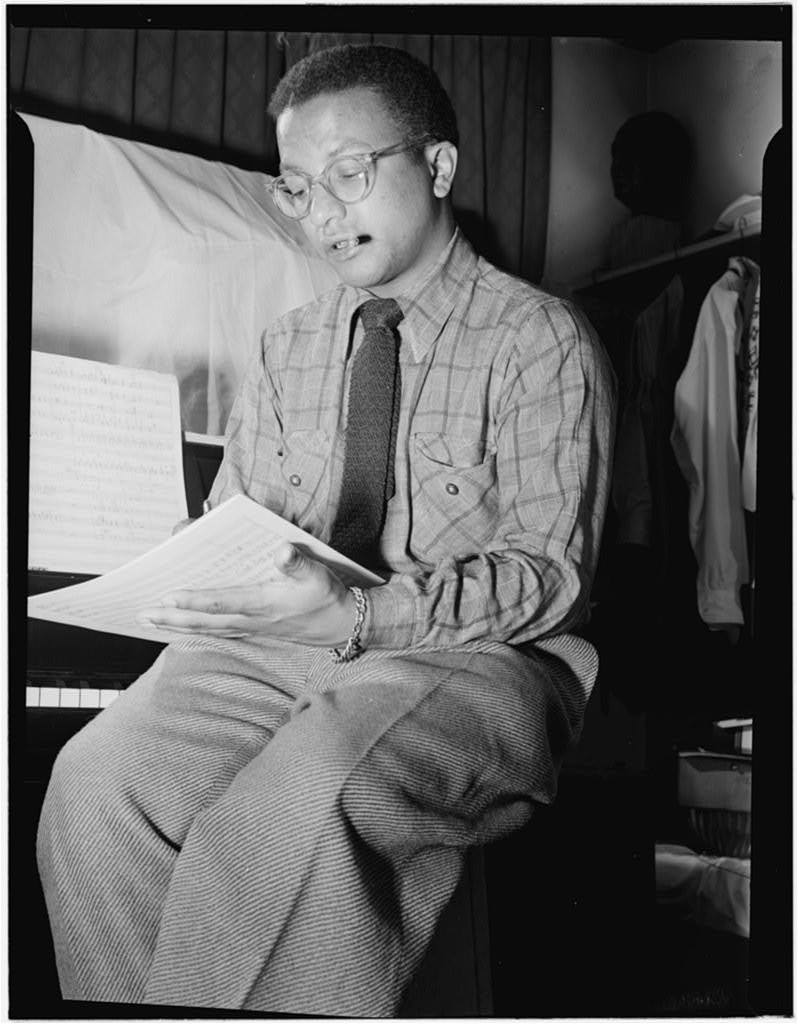
Billy Strayhorn's talent


The relationship between Billy Strayhorn and Duke Ellington is one of the curiosities persistent gender bias fed gossip and irrelevant.
By 1938, when Strayhorn, overcoming her shyness, was presented in a theater in Pittsburgh, the Duke was to be closer to the customs of the night, fraternization with musicians and others with whom they shared food and drink but certainly the impact it generated Billy Strayhorn lasted until his death early in 1967 from cancer.
Duke is likely to have been dazzled by the tiny character that I admired and knew by heart addition to Brahms, Beethoven and Bach and other cultural affinities.
was also black and was unknown to himself.
Otto Hardwick, Sonny Greer and Juan Tizol, the most guilty of the band, made fun of their size and their edges homosexuals. I named Sweet Pea (from Popeye's son) but also from their income admitted they were in company with another genius.
"Lush Life" was key to convincing the Duke of his talent. She took him to live with his son Mercer and his sister Ruth, who had more or less the same age, and appointed him a member of the family.
Gradually Ellington was mutating and the way I was going to the public in their clothes and even the titles which apply to their work. For many, this time Duke did his most ambitious works, including Johnny Hodges, without losing its admirable collection of swing, was Acquiring sympathy for the ballads, many of them written by Strayhorn. The same happened with Ben Webster, another inmate convert.
is difficult to know which part of the compositions written by Ellington in this stage have Strayhorn aid, but no one has denied its authorship in some crowning achievements of the orchestra as "Take the A Train", "Chelsea Bridge," "Passion Flower", "Johnny Come Lately" and the posthumous "Blood Count", written in the hospital.
the death of Billy, Ellington was true as ever: "It was incomparable and infinite patience. He had no aspirations to enter any competitions, but his legacy will never be less than definitive at the highest level of culture ".


Billy Strayhorn's classic "Take the A Train" played by the orchestra of Duke Ellington and Ray Nance being solo. Delicious
and modern saxophones arrangement behind the trumpet solo.