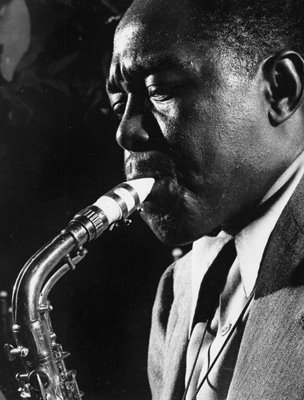
For several legendary night sessions at the club Minton's in New York ended germinated style Jazz pushing towards a downward spiral of creativity that made him the twentieth century classical music.
The Bop, with the help of pioneers such as Dizzy Gillespie, Thelonious Monk and Kenny Clarke was counter bomb that shook the foundations of postwar American society, a society excited and eager to discover new horizons after the tragedy. However, nothing had been the same without a leading figure, a brilliant artist who served as a reference for this radical redefinition of jazz that forever changed the playing of the musicians and the way we listen to the fans.
Charlie Parker, the archetype of unpredictable musician hit by drugs and alcohol, possessed the divine gift of creativity coupled with an amazing technique allowed him to reach the highest peaks of expression certainly reached the pantheon of historical figures traveled so far by other revolutionaries such as Louis Armstrong or Duke Ellington. And all this despite his tortuous life peppered with scandals and painful premature death at age 35. Dial Records
The company was founded by Ross Russell in Hollywood in 1946. The recordings of Charlie "Bird" Parker for this label are among the most essential of its production in importance only comparable to that of the Savoy or the Verve.
The two volumes reviewed here contain all of the 8 selected footage recorded sessions, but some gems like the Jam Session recorded Kopely Chuck's house in Los Angeles or several selected outtakes, of which the most interesting from a historical perspective is that of the famous "break" high "Night In Tunisia."
In the first session you can listen to Bird by session musicians on the west coast (aside from a very young Miles Davis) playing authentic classic new-style, mostly based on basic structures like the blues or standards Tin Pan Alley. Bird reconstructed at will their musical heritage, producing new melodic lines that run with a rich profusion of notes accurate harmonic bases generally known as a frenzied tempo. These sessions are particularly dramatic piece and a great interest history: the famous Loverman interpretation, where the attentive listener can almost feel the tense atmosphere prevailing: Bird improvises in a chaotic, entering at the wrong time and tune in a completely unusual for a musician of his caliber. The musicians who accompany him look at each other and played with little conviction, making sure it is not valid due to the catatonic state of their leader.
Then come The Gipsy, BeBop and after the collapse of Parker, which collapses in the recording studio. That night a room at the Civic Hotel in Hollywood erupted in flames. Parker, under the influence of phenobarbital, was handcuffed and sent to county jail where would his bones in the Camarillo Hospital for detoxification. Pure Jazz history.
The other sessions are great, because after their stay at Camarillo Bird lived in a period of some mental stability. Back in New York and the aura of myth on its head, began looking for musicians to form a stable quintet. Miles Davis, also back, was an obvious choice for the trumpet. A solid rhythm section formed by Duke Jordan on piano, Tommy Potter on bass and Max Roach sensational completed a battery like no other combo that helped to swell the legend. The Bird of these recordings is a musician relaxed, great shape both mentally and physically, it dumps all the intensity of his emotions in his masterful improvisation. Miles Davis makes its own usually means records, especially in the ballads, which proves that inspiration can be where there are no pyrotechnics (this is one of the findings of Davis who became a myth in its own right). Max Roach turns his solos and accompaniment to the understanding of modern drumming.
immortal ballads like "Embraceable You", "Do not Blame Me," "My Old Flame." Fast tempos like "Scrapple From The Apple" (based on the chord sequence of "Honeysuckle Rose"), "Dexterity" and "Crazeology" ("I Got Rhythm") nervous and frantic blues like "The Hymn" ("Wichita Blues") or mid-tempo as "Bongo Bop".
An incomparable musical legacy that the good amateur should be known almost by heart. Essential.
television Notable historical document of 1952, where Earl Wilson and Leonard Feather gives them the prize of the magazine "Down Beat" with Parker and Gillespie to be the best saxophonist and trumpeter best respectively 1951.
Then run a very good version of "Hot House" accompanied by Dick Hyman on piano, Sandy Block on bass and Charlie Smith on drums.


0 comments:
Post a Comment