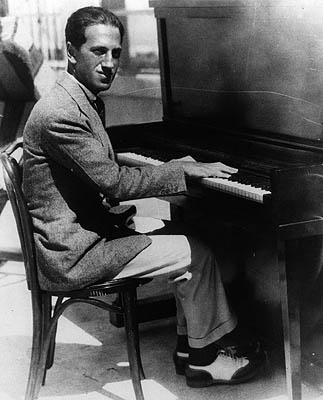
The opera takes place in Catfish Row, a black settlement in Charleston, South Carolina. Gershwin believed strongly that it should be played by blacks but at that time was difficult to find black artists with experience in ópera.Gershwin was all the time involved in casting and production of his opera. Todd Duncan, first Porgy, remember that the composer "was all over the country hoping for Porgy." It also notes that when he finally decided to hire him, told him he only had to sing two or three songs as a test but really did sing for over an hour and a half. "It was amazing. At one point George Ira and I pulled the score of the hand and began to sing them with her horrible voice and aged but with much feeling that I did mourn, "says the first performer of Porgy.La play opened in September 1935 in Boston and was received enthusiastically by audiences and critics. With some changes again to New York on October 10, 1935. There were only 124 roles of Porgy and Bess on Broadway and only a few years later the money was recovered invested. Never was very well received. A large number of black critics and composers as Duke Ellington, criticized the opera. "No black man would fool Porgy," Ellington said in a note periodística.Dos years after the premiere, Gershwin died of a brain tumor. It was just before turning 39 years old. In 1959 there was a film version produced by Samuel Goldwyn and directed by Otto Preminger who was severely criticized for portraying stereotypes. For years, Porgy and Bess was more successful in Europe, where he was considered "the real American opera", which in the Unidos.La first complete version of Porgy and Bess in their country of origin was in Houston in 1970, directed by John Main with great success. Was finally produced at the Met 50 years after the first producción.El merit of Porgy and Bess is the only opera based on the jazz of the '20s and '30s who survived after the post-war period where composers began to use jazz as a satire. But above all, many critics believe that the great contribution of this work is to achieve a union between the individual artistic context and socio-historical. The truth is that the time was ripe for the merger of serious art and popular culture. It was a moment of great crisis and social questions that raised many protest movements in the arts. Hitler came to power and fascist cause, condemned by the Jews, was in his apogeo.Gershwin was not a man interested in politics, at least in public life. However, it is possible to appreciate his teachings on some of his work. Before Porgy and Bess worked in a series of satirical shows maverick character. He cared for the great political issues of the moment can be seen in a letter he wrote to a friend, telling how he spent that summer on the island inspiration for the opera: "We sit at night with our pipes to watch the stars. With my friends always talk about two favorite subjects: Hitler's Germany and women of God. " In the musical, the composer was inspired by the pop and concert music. In both areas innovated, writing songs and musicals for Broadway. Among his works include Rhapsody in Blue (1924), Piano Concerto in F (1925), American in Paris (1928) and Cuban Overture (1932). Through these works, and Porgy and Bess, Gershwin became undoubtedly the American pianist and composer with higher quality and successfully managed to combine elements of jazz and American folk tunes, playing some of the issues depths of the human condition.
no doubt "Summertime" is the most famous song from the Gershwin opera. This video is a presentation of Ella Fitzgerald in Berlin in 1968 and is almost a gospel version and the best I've played in his career.


0 comments:
Post a Comment