
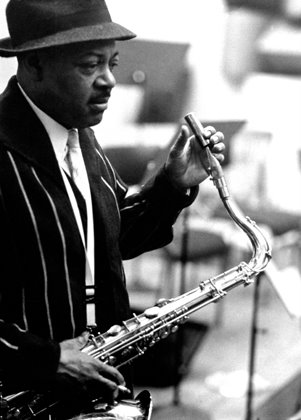
While it is true that Adolphe Sax invented the saxophone, the first and most fundamental chapters the history of the instrument were written by Coleman Hawkins, the first important jazz tenor saxophonist and one of the greatest of all time. Permanent and modern improviser, his encyclopedic knowledge of chords and harmonies gave effect for five decades to par with any competitor. Coleman Randolph Hawkins (nicknamed "Hawk" and "Bean") was born on 21th November 1904 in St. Louis, Missouri, in the heart of a wealthy family.
his five years he studied piano, switched to cello at age seven, and two years later took up the tenor saxophone, an instrument was not used then in jazz, and in the marching bands and orchestras popular, is played with a technique that a lot like that of circus musicians. By 1914
start academic music studies completed in Chicago, a city to which he moved with his family in 1919. Here is the first opportunity to hear jazz and symphonic music. In 1920 he was hired by the blues singer Mamie Smith, who had in his band with top musicians such as Buster Bailey and Sidney Bechet. With it will come to New York and recorded his first album, contributing some solos, which opens the way jazz musicians in the best circles of the city.
No wonder, then, that in 1923 he joined the Fletcher Henderson orchestra, which would the first big band in jazz history and which remain Hawkins eleven. One of his companions will be the trumpeter Louis Armstrong, who makes much of its resources melodic, rhythmic and technical, improving both its robust sound. So, Hawkins will become the most important soloist with the orchestra, gradually forming the original and personal style which will soon also start to copy dozens of saxophonists. In 1934 it
career in Europe, recorded in Holland and France. Return to the U.S. in 1939 to compete with former students and many imitators, and its main rival other tenor, Lester Young, who curiously practiced a completely different style to yours. Soon reaffirms its leading position and put together his own orchestra, with which he recorded his historical version of "Body and Soul", about his definitive consecration. Coleman Hawkins was revered throughout his life, and somewhat feared, in an absolutely unanimous by his fellow musicians, whether young or old, whatever the instrument to execute.
In the forties will be interested in new trends and the young musicians who practice them. Their adaptation to the times you will gain experience with the players of the bebop revolution, and later joins the intellectuals of cool jazz. Hawkins had earned the reputation as "terrible" for his chilling technique, his incomparable knowledge of harmony that allowed him to link chords imperceptibly, and an ability to create at any time, no matter how fast it was, improvisations that always touched the master and a perpetual swing. Coleman Hawkins
maintained its dominance until shortly before his death, a victim of pneumonia, May 19, 1969 in New York. So the man went to the tenor saxophone was what Armstrong had been on the trumpet. He invented the first and therefore most important instrument rules concepts and language that would determine the tenor saxophone in the jazz any time. His influence on other specialists such as Ben Webster, Chu Berry, Don Byas, Sonny Rollins and John Coltrane is undeniable, and also art that goes beyond any possible calculation.
"Body and Soul" was recorded by "Bean" in 1939 and is considered the cornerstone of the modern tenor saxophone.
version of this video was recorded at the Poplar Town Hall in London in 1967, during the tour of Jazz at the Philharmonic, and accompany the pianist Teddy Wilson Hawkins, bassist Bob Cranshaw and drummer Louis Bellson.


0 comments:
Post a Comment